(Version 3)
| Construction | Destruction Testing | Flight Testing |
|
Documented here is a construction technique for an experimental APD for Bolts that will work with Target Style Crossbows. Please try this yourself with your own crossbows and help report the findings from using this. I apologize for the 'haphazardness' of this page, but it has been quickly modified through various incarnations of this APD. A clean version will come later. |
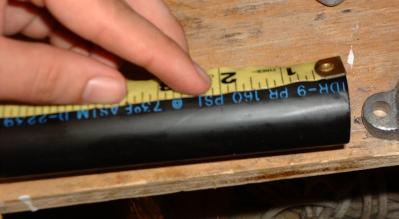 |
Step 1: (Actually used 1" top this time) |
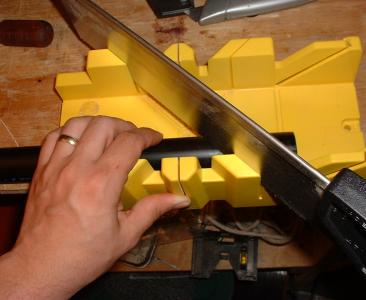 |
Step 2: (Actually used 1" top, leaving a 2" bottom) |
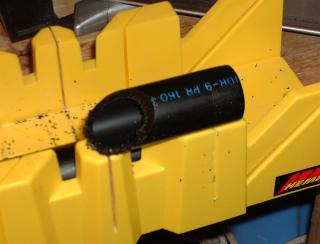 |
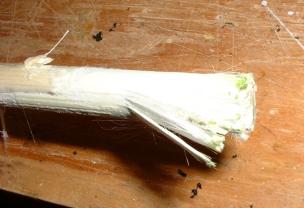
Step 3: The look of the finished cut. Note if you can (blurry picture) that there are rough edges all around. |
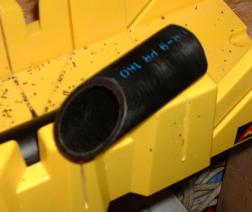 |
Step 4: Use a utility knife to carve the 'plastic fringe' away, as well as to round the edges of both the front & back ends. Use sandpaper to further make the edges nice and smooth. |
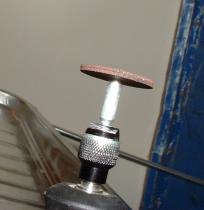 |
Step 5: Mount 2 Heavy Duty cutting blades together on a dremel to allow for a 'wide cut' [NOTE: 3 regular blades would give a similar effect, or one could also use a hot knife or taped together hacksaw blades] |
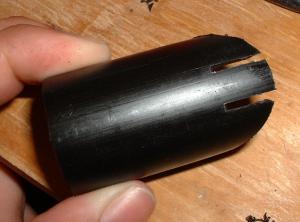 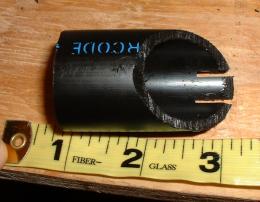 |
Step 6: Using the dremel, cut parallel cuts in the front of the bottom of the tube. These cuts should go 1/2" deep (or a little more), and should be approximately 1/2" apart (or a little more). |
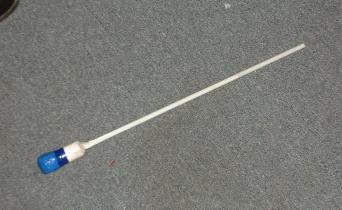 |
Step 7: Prepare a bolt for accepting the APD. This is a Markland style bolt which is completely wrapped in strapping tape, and has no fletches. [NOTE: Yes, this is a HUGE bolt. It is 3/8" thick fiberglass, and is about 20" from nock end to the back of the bolt head. The crossbow that I have to use these on has a VERY long draw (13"). I have plans to make a smaller version with the APD as well, I just had these laying around to try them on.] |
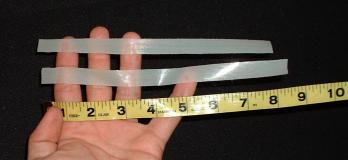 |
Step 8: Take ONE length of 1/2" wide strapping tape, at about 8" long. |
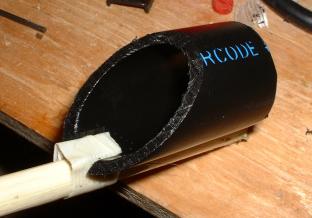 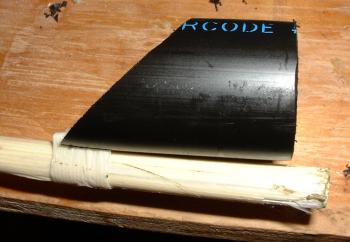 |
Step 9: Attach the front of the APD, trying to make sure that the APD is 'basically straight' with the shaft. Do this by taking a piece of tape, and running it through, and around the slots & shaft. Keeping it as tight as possible. Note that the end of the APD needs to be AT MOST 1/2" from the butt of the bolt/arrow. |
 |
Step 10: Cut a 1" wide strip of strapping tape, about 24" long. |
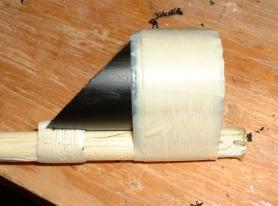 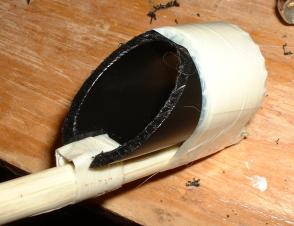 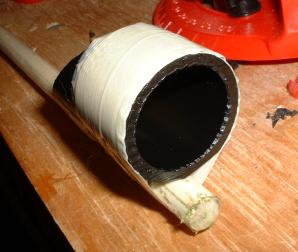 |
Step 11: Attach the back of the shaft, It is hard to keep the butt end straight while doing this, but take your time. Accomplish this by wrapping the tape all the way around the APD and the shaft. Do it tightly for security, and to avoid wrinkles (especially on the bottom of the bolt). |
| Afterthoughts: Compared to version 2, this one feels like it has a little more wobble in it, due to the 'less tight' taping on the back. However it is very secure front/back wise. It flies very well, comparable to the 2" versions, although the butt end rotates a little more. But it seems much less affected by the wind, and has a further range. |
|
|
Destruction Testing I did a few things. First of all I fired this shaft full force from a 42lb, 13in draw crossbow into the dome of a helm twice from 15ft. The blunt stayed firmly attached. I then decided to test the actual AP qualities of it. I took the shaft, and stood about a yard from a helm. I placed the shaft on my crossbow, and pulled it back about 9" of the 13" manually, held the end of the blunt approximately 2 feet from the grill on the helm (to make sure it hit the grill), and released. After a loud clang, everything was intact. I repeated this experiment again, and again, and again. I fired it 30 times in this method, with the APD holding firm, not budging a bit. I then got tired of this, and decided to fire it full force backwards into the helm from around 5 feet. The shaft itself actually split from the force at this point, and in it's splitting, ripped tape in the process. Note however that the APD still kept it from entering at least 3/4", as that was it's final placement on the shaft. This was pretty extreme testing, and I feel that to me, these APD's are very safe when made in this manner. Details are below. |
|
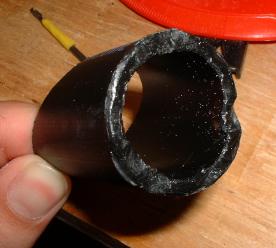 |
The APD after being brutally smacked into the helm 30+ times. |
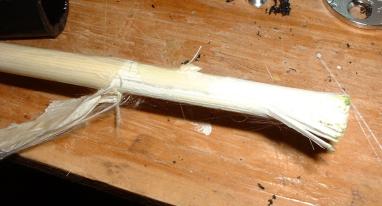  |
Here you can see where the shaft split after the full force firing, causing a slight dislodging of the APD. |
|
Afterthoughts: |
|
|
Flight Testing The most recent test results are in, and are very promising. I managed to get out to the range this weekend and in decent conditions get firing with multiple crossbows, and multiple ammo types. I think the results speak for themselves. So let's start with them. These were conducted in a similar manner to the original testing done below, except that these were not done with a level to keep them at 45 degrees, but instead kept at approximately a 30-35 degree angle aim, by using a consistant aim point.
Based upon the above statistics, and my own feelings from shooting I have the following opinions. The 1" Tubes simply fly better. They are much less affected by the wind, and they have greater distance. The difference in angles seems to be a 'catch 22'. The longer angle makes for a heavier blunt (assuming the same top length), and therefore reduces distance further. However, they are 'slightly' more stable in flight (Note the word slightly). I personally feel that it will be personal preference in these matters to the archer, whether they feel the lessened distance is worth the slight stability. Both version are highly accurate, I was able on the 2nd shot to hit a 6 inch wide light post from 50yds with the 1" blunts (first one hit the 'feet', cause I didn't aim high enough). These flight tests, combined with the destruction tests, I feel indicate that these APD's are safe and effective on a combat crossbow, and that a 1" top is all that is needed/required. The original flight testing is included below, as it is still valid.
|
||||||||||||||||||||||||||||||||||||||||||||||||||||||||||||||||||||||
Webbed by: Lord Siegfried Sebastian Faust (mka Eli White) (eliwhite@adelphia.net)