Tube Style ABD/APD for Target Crossbows
(Version 2)

PROBLEMS:
     It turns out that when hitting 'perfectly', the non-tab side of the slots on the rear would curve in, allowing the APD to enter the helm further than legal. Not Safe.


Construction | Destruction Testing | Flight Testing

     Documented here is a construction technique for an experimental APD for Bolts that will work with Target Style Crossbows. Please try this yourself with your own crossbows and help report the findings from using this.

(Go see Version 1)


Step 1:
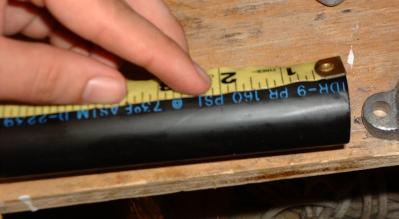
Purchase some Siloflex tubing (ASTM-2239, 160psi, 1" inner diameter, polyetheline tubing). Mark a 2" section of it off.


Step 2:
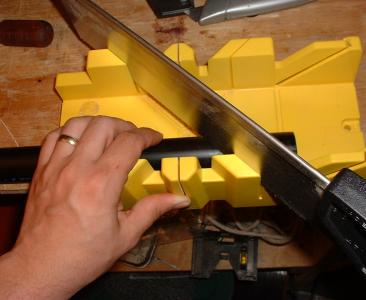
Cut the tubing at a 45 degree angle, leaving the 2" section as the 'top' of the 45 degree angle, thereby making the bottom of the tube about 3".
[NOTE: Why this length? It just feels right, any shorter 'looks too flimsy', and any longer seems like overkill]

Step 3:
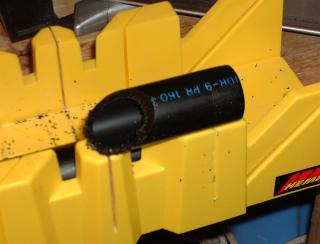
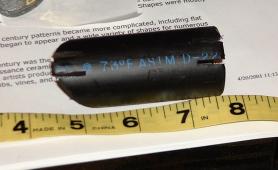
The look of the finished cut. Note if you can (blurry picture) that there are rough edges all around.
Step 4:
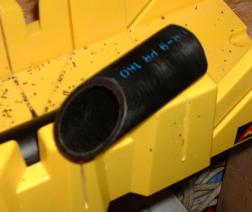
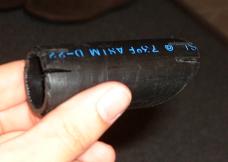
Use a utility knife to carve the 'plastic fringe' away, as well as to round the edges of both the front & back ends. Use sandpaper to further make the edges nice and smooth.
Step 5:
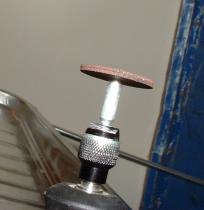
Mount 2 Heavy Duty cutting blades together on a dremel to allow for a 'wide cut' [NOTE: 3 regular blades would give a similar effect, or one could also use a hot knife or taped together hacksaw blades]


Step 6:
Using the dremel, cut parallel cuts in the front and back of the bottom of the Tube. These cuts should go 1/2" deep (or a little more), and should be approximately 1/2" apart (or a little more).
Step 7:
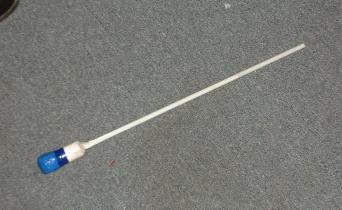
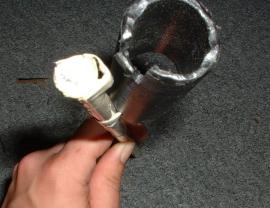
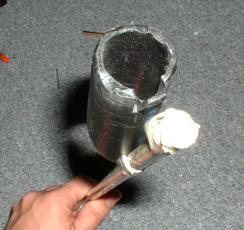
Prepare a bolt for accepting the APD. This is a Markland style bolt which is completely wrapped in strapping tape, and has no fletches.
[NOTE: Yes, this is a HUGE bolt. It is 3/8" thick fiberglass, and is about 20" from nock end to the back of the bolt head. The crossbow that I have to use these on has a VERY long draw (13"). I have plans to make a smaller version with the APD as well, I just had these laying around to try them on.]
Step 8:
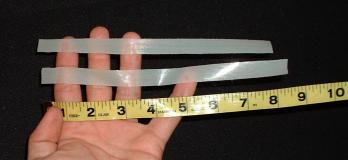
Take two lengths of 1/2" wide strapping tape, at about 8" long.


Step 10:
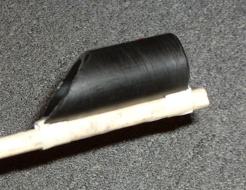
Attach this to the shaft, trying to make sure that the APD is 'basically straight' with the shaft. Do this by taking a piece of tape, and running it through, and around the slots & shaft. Keeping it as tight as possible. (Sorry for the blurry pictures)
Afterthoughts:
     Compared to version 1, this one is much more stable on the shaft, it can barely wiggle left/right. And in fact, it is amazingly hard to make it move forward & back.

Destruction Testing

     I did a few things. First of all I fired this shaft full force from a 42lb, 13in draw crossbow into the dome of a helm twice from 15ft. The blunt stayed firmly attached. I then decided to test the actual AP qualities of it. I took the shaft, and stood about a yard from a helm. I placed the shaft on my crossbow, and pulled it back about 9" of the 13" manually, held the end of the blunt approximately 2 feet from the grill on the helm (to make sure it hit the grill), and released. After a loud clang, everything was intact. I repeated this experiment again, and again, and again. On the 20th firing like this, the APD failed. HOWEVER, it still protected, did it job, but 'broke' in the process. This was pretty extreme testing, and I feel that to me, these APD's are very safe when made in this manner. Details are below.

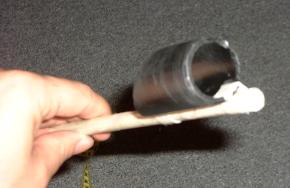
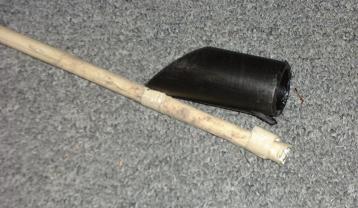
As you can see, in it's 'failed' form, nothing actually broke, the blunt was just pushed forward with enough force that the combination of a slight bending of the forward tape, and a bending of the rear tab, allowed the blunt to 'slip out' of it's rear binding. This still allowed it to do it's job, and it is now obviously failed, and needs repairing. [NOTE: I played with the tab afterwards, and don't feel that it is adversely affected, and therefore one could still bend it back into place, remove the current tape, and retape it on.]


Here you can see the effects on the back end of the APD, and the shaft. They both were getting dented fairly deeply. Yet held on during all this time.


Afterthoughts:
     One could, theorectically, make this EVEN STRONGER if they wished by instead of cutting 'tabs', cutting slots in the middle of the tube, and running the tape there. The problem of course is that running the tape through these tabs required me to waste a bit of tape until I was able to 'get the hang of it', and even then it isn't a walk in the park. Trying to run tape through a slot, multiple times, with a long piece trailing, is going to be neigh impossible.
     But overall, I think that this style has passed it's torture test in it's current incarnation. If additional protection is felt necissary, then simply increase the tab length to 3/4" in each direction (and maybe increase the length of the blunt).

Flight Testing

     First of all, I think my previous statement about the 'high wind problems' with this APD's are unfounded. I had previously attempted to do testing during high wind, and when I fired the bolts at a 45 degree angle, the tail ends got 'caught' by the wind and did nasty things, causing the bolts to rise, then drop like a rock.

     It turns out it seems that it isn't the wind (so much) as it is the bow I was using. The bow I was attempting to use is my 'current' combat crossbow, which was already destined for the trashcan. It is a 42lb, 13in draw bow, made with two fiberglass electric fence posts lashed together for it's prod (Extremely inefficient). The thing was very inaccurate from the first place, and it's release mechanism was a 'disappearing posts' method. It has two metal posts that stick up out of the stock that the string is pulled behind. You pull the trigger, the posts pull downward. I KNOW that this bow has some level of uneven pull on the prod sides, and I know that the release mechanism is probably (A) causing some amount of string jump, and (B) allowing one to go a second before the other.

     In any case, I went out to do testing again, this time in 'no to slight' wind. And the problem still existed. It seems to be a problem with this bow. Something about the way this bow shoots causes this to happen. Noone else has reported this problem though, and so I feel it is this crappy bow exaggerating the problem.

     Through testing, I did find that with a 'good bow' a gust of wind can still catch a bolt, but it's path is not modified nearly as greatly, and it rarely happens in fact. Also note that this really only applies to high angle shots (30 - 45 degree, which don't happen all that often with a crossbow in combat situations).

     Anyway, to continue testing I grabbed my target crossbow. It is WAAY overpowered for a combat crossbow, but I wanted to see how these flew in relation to each other, and I feel that the relative changes based upon design would still apply, no matter what the draw weight. This crossbow is 125# at 8 inches. Therefore making 1000 in-lbs. Again, a BIT overpowered for a combat bow using this ammo, but hopefully good data none the less, I look forward to seeing other people's testing results with a decent combat crossbow.

     I made multiple APD's for testing. My test cases were a 'regular' blunted bolt, a 2" top 45degree APD, a 3" top 45degree APD, and a 2" top 4" bottom ~30degree APD. I shot these in succession, hoping to equalize the current conditions for each volley. I did this 10 times, with my lady wife standing near the landing zone, with a measuring tape stretched out along the ground, watching for where it landed, and recording the distance. I used a 45 degree angle level, which I held with my thumb on the shelf of my crossbow to ensure an exact 45 degree launch each time. The wind was variable, but slight. Only one bolt 'tumbled' due to wind, this was the 3" APD, and this tumble is not included in the statistics. The results & comments follow:

Bolt Style Average Distance % Loss from Regular Comments
Regular 210.7 ft - The control bolt. It was flying just fine.
2" APD 184.0 ft 12.8% This was the second most stable design in flight. The rear end would twist and tumble a bit, wave from side to side in the wind, but the head always stayed on target. It also was the longest shooting.
3" APD 161.6 ft 23.3% This was bad. Not only was range adversely affected by the extra weight/drag, but this one was highly affected by wind. It would often curve to one side or another easily at a slight gust. Was very unstable in flight compared to the 2" even in no wind conditions.
30 Degree APD 181.8 ft 13.7% This guy had slightly less range than the 2" APD, but almost immeasureably so. However, this bolt was VERY stable in flight. It was almost always heading true, butt following front nicely. Was a joy to watch these fly.

     My overall feeling after this is that going to a 3" APD is definately too much (and destruction testing shows that 2" holds up fine). It seems that either the 45 degree or the 30 degree works fine. The 45 degree gets a hit more range, and is still accurate. The 30 degree looks beautiful in flight, and perhaps is slightly more accurate. Archer's choice.

     My biggest comment comes from after this testing, just doing some shooting with them. I went shooting for a bit, and was doing a few different things. For one, I fired the blunts at 'normal long combat range' I picked a good aim point, anchored, and let loose at probably around a 15-20 degree angle. At this angle, the 2" and the 30 degree flew beautiful, straight, on target, and went around 120 feet (the regular went only a few feet farther, around 125). The 3" one still had a bit of accuracy problems, and dropped a bit shorter. So at the 40yd range, it seems either 2" works just fine, and the difference in distance isn't in the 10's of percents, but more around 5%. I did this a number of times. I also fired at a few trees from varying distances (15ft to around 60ft). I was able to bullseye the tree accurately with the Regular, 2" and 30 degree blunts. The 3" was almost equally accurate, but wobbled a fair bit while doing it. It's back end sometimes visibly dropping (due to drag/weight?).

     So overall I think these things work great. But just have a few issues with being shot at 45 degree angles. They like their angles a little bit lower, which is fine for 98% of all Combat Archery that I have been in.


Webbed by: Lord Siegfried Sebastian Faust (mka Eli White) (eliwhite@adelphia.net)